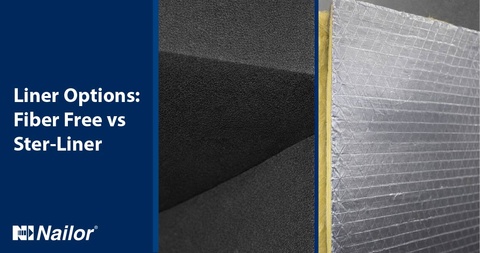
Terminal unit liner selection is an important consideration in applications where insulation fiber migration must be controlled. While most insulation materials are rated for high‑velocity airflow, some projects call for additional measures to help prevent fibers from entering the airstream and to support long‑term durability within the unit.
Nailor offers two liner options designed to address these requirements: Steri‑Liner® and Fiber‑Free insulation. Both options are used within the industry, but they differ in material composition, attachment methods, and long‑term performance characteristics.
Steri‑Liner®: Foil‑Faced Fiberglass Construction
Steri‑Liner® features a smooth, non‑porous foil‑faced fiberglass insulation designed to limit fiber erosion, resist moisture penetration, and provide a cleanable liner surface.
The foil facing over the fiberglass insulation acts as a vapor barrier, reducing moisture exposure and helping lower the risk of micro‑organisms becoming trapped within the liner. The smooth surface also facilitates cleaning and helps prevent surface erosion over time.
Steri‑Liner can be permanently glued to the sheet metal surface of the terminal unit and is secured at the edges using metal Z‑strips, which help seal liner edges and reduce the potential for insulation migration into the airstream. Additional material and performance information is available in the Steri‑Liner Liner Options submittal (Steri-Liner Data).
Fiber‑Free Insulation: Closed‑Cell Foam Construction
Fiber‑Free insulation is a closed‑cell foam liner option designed to eliminate exposed fiberglass within the terminal unit. The closed‑cell structure inherently prevents fibers from entering the airstream and offers resistance to moisture absorption.
Unlike foil‑faced fiberglass liners, Fiber‑Free insulation does not require protective edge retainers. It is typically glued and pinned directly to the sheet metal interior of the terminal unit.
Because the closed cells within the foam are filled with air, the material expands and contracts with temperature changes. Over extended periods, this movement can weaken adhesive bonds and enlarge pin penetration points. As a result, the insulation may loosen from the unit walls, which can degrade its insulating effectiveness over time.
Detailed material characteristics and performance information for Fiber‑Free insulation are provided in the Fiber‑Free Liner Options submittal (Fiber-Free Liner Data).
Proven Performance Over Time
Both Steri‑Liner and Fiber‑Free insulation have been used successfully in HVAC applications. However, Steri‑Liner has a significantly larger installed base, with performance documented over a longer period of service.
For applications where long‑term insulation retention, durability, and consistent liner performance are priorities, Nailor considers Steri‑Liner to be the superior choice, offering reliable insulating characteristics over the life of the unit.
Related Reference
For additional technical background, see Nailor Engineering Bulletin: Terminal Units – Liner Options – Comparing Fiber‑Free to Steri‑Liner (Revised February 12, 2026). Terminal Units – Liner Options